Australia Confirms 185,000 PR Cap for 2026–27: Essential Migration Updates
Australia has confirmed 185,000 permanent residency places for 2026–27. While total allocations hold steady, massive shifts favor onshore applicants and employer-sponsored streams. Discover the targeted high-demand occupations, tightening state nomination requirements, and student visa compliance
Synopsis:The Australian Government has finalized its 2026–27 Permanent Migration Program planning levels, holding steady at 185,000 visa places. While the headline figure matches the previous fiscal year, a major structural shift heavily favors employer-sponsored applicants and onshore temporary residents. This comprehensive guide details the new 70:30 Skill-to-Family stream split, rising state nomination caps, critical tech and construction bottlenecks, and strict compliance updates for international students looking to secure Australian permanent residency
Australia has officially announced 185,000 places for permanent visas in 2026–27, providing ample chances for skilled migrants, engineers, health professionals, tradespeople, and IT experts from around the world.
The number in the headline is encouraging, but it’s not as simple as it might seem.
The Australian government is also taking steps to diminish overall migration levels, enforce stricter visa requirements, and prioritise visa holders who would be able to contribute to Australia to address key labour shortages.
For those seeking Australian Permanent Residency (PR), state nomination, or a visa in the skilled visa subclass, it’s important to stay informed about these changes to boost your chances of a successful application.

Australia Migration Program 2026–27 at a Glance
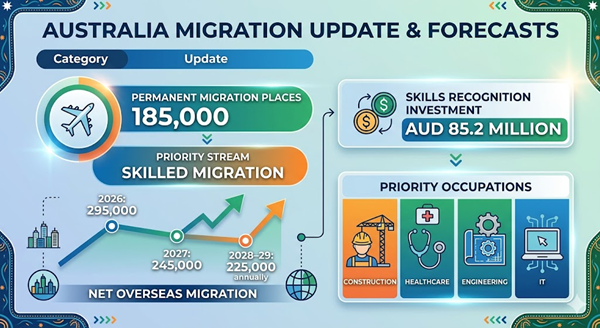
The government’s priority is to tackle staffing vacancies and to keep migration at sustainable levels.
South Australia Emerging as a Major Opportunity
Labour shortages persist in various industries in Australia.
The demand for skilled people has grown because of large-scale infrastructure, renewable energy projects, residential, health, and defence construction projects. This means that the majority of migration allocations in the 185,000-place migration programme are likely to be allocated to the Skilled Migration Stream.
High-Demand Occupations in 2026
- Civil Engineers
- Mechanical Engineers
- Construction Project Managers
- Electricians
- Plumbers
- Registered Nurses
- Aged Care Workers
- Software Engineers
- Cyber Security Specialists
- ICT Business Analysts
- Quantity Surveyors
- Surveyors
People who apply for these occupations may receive better processing times, better chances for nomination and better chances of being invited.

AUD 85.2 Million Investment to Speed Up Skills Recognition
Australia is investing AUD 85.2 million in the latest migration strategy to modernise the skills assessment and professional recognition systems.
The purpose of the initiative is to:
- Reduce assessment delays
- Streamline occupational licensing
- Recognise overseas qualifications faster
- Improve workforce integration
- Address labour shortages more efficiently
One of the most challenging obstacles for overseas professionals to overcome has often been the skills assessment process. The ability to recognise these pathways faster would have a major impact on decreasing the waiting time for eligible applicants.
State Nomination Programs: Increasingly Competitive
Although migration targets are still set high at the federal level, the competition for state nomination programmes has dramatically increased.
A number of jurisdictions have filled up or imposed caps at the end of this fiscal year.
State Nomination Status Overview
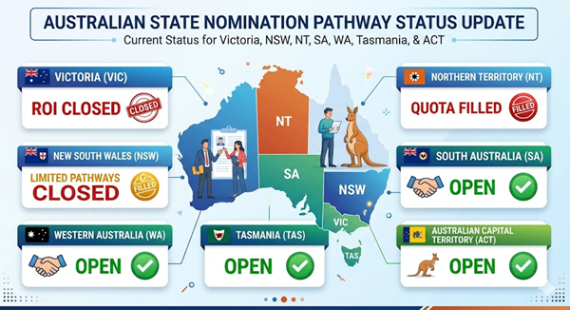
This does not imply that state nominations will be ongoing forever.
Many states are now targeting specific occupations, industries, and workforce shortages rather than issuing broad invitations.
South Australia Emerging as a Major Opportunity
South Australia remains a popular place to come for skilled migration, receiving more attention than all other jurisdictions. The state is currently considering SkillSelect profiles for over 250 occupations, and the good thing is that offshore construction workers have an advantage.
While some jobs in South Australian construction need three years of experience, some may only require one year.
Australia is still suffering from a shortage of housing and has significant infrastructure plans in place, which makes construction-related occupations particularly appealing.
Tasmania Continues Issuing Invitations
Despite the competition, Tasmania continues to be active. On 4th June, Migration Tasmania issued:
- 44 invitations under Subclass 190
- 27 invitations under Subclass 491
During that round, the minimum Green Pass ranking score was 500.
It is now more important than ever to maintain a high points score and accuracy within the profile for candidates aiming for Tasmania.
International Students Face Greater Scrutiny
The Australian student visa system is also undergoing major changes as well.
There is a strong emphasis by the government that the student visa is not an automatic route to permanent residency
New compliance activities include:
- Genuine student requirements
- Course progression monitoring
- Visa condition compliance
- Education provider oversight
- Onshore visa switching practices
An increased focus on students who have multiple course changes or seek to use an educational trajectory primarily for migration.
What This Means for Students
International students wishing to study at the college need to:
- Select courses that are relevant to a career path
- Ensure visa conditions are fully adhered to
- Do not centre migration forecasts on future projections
- Ensure that the demand for skilled occupations is tracked for change.
The environment for migration is becoming more and more compliance and selection-based.
India Becomes Australia’s Largest Overseas-Born Community
A significant milestone has also been passed with regard to the demographics.
The latest statistics show that Indians are the largest group of overseas-born Australians in India, surpassing the number in England.
This reflects:
- Strong economic ties
- Growing educational links
- Continued skilled migration demand
- High participation across priority industries
The trend reflects the continued reliance on highly skilled migrants from India and other major source countries in Australia.

What These Changes Mean for Future Applicants
The bottom line of Australia’s migration policy for 2026 is quite unambiguous:
Australia is open to migration, but not for everyone. There are excellent prospects for candidates with skills in high-demand sectors. But competition is growing, compliance is more stringent, and state nomination processes are more focused.
Candidates who are active, score competitively and specialise in jobs that match labour market demand will be best equipped to go forward.
Final Thoughts
The confirmation of 185,000 permanent migration places for 2026–27 demonstrates Australia’s continued commitment to skilled migration. Meanwhile, the government’s policy to cut down on general migration also suggests that the age of quantity has given way to quality.
Ongoing demand is strong for highly trained individuals in construction, health care, engineering and technology. With an ever-more-competitive migration landscape, planning, accurate documentation and early applications can be the deciding factors.
Knowing what is happening is one of the most important steps that you can take to work towards your migration goals as Australia changes its migration system.
